

East out of Trinidad
The Great Plains include eastern Montana, Wyoming, Colorado and New Mexico; the western part of North Dakota, South Dakota, Nebraska, Kansas and Oklahoma; and pieces of Texas. Generally east of the Rockies so no mountains; hundreds of miles from the oceans, hardly a tree in some spots.

A lonely tree
Just me and you and a dog named boo
Travellin’ and livin’ off the land
Me and you and a dog named boo
How I love being a free [wo]man…
I can still recall
The wheat fields of St. Paul…
Couldn’t resist because I miss traveling with Max. (Thank you Lobo)

All gone to the city
But I digress!

So many left to die
I drive back and forth over much of this territory almost every summer. Crisscrossing to try new roads or catch a bit of history, sometimes just trying to get to my destination, sometimes happily meandering. I complain but at the same time it’s like getting to the heart of the matter or rather the center of the nation, for better or worse. A large sign: Another Tea Party Patriot.

Why are abandoned houses so beautiful?
Abandoned houses and tiny towns by the dozens. Horses, cows, burning, bleak, highway, field, highway, stripes of horizon.
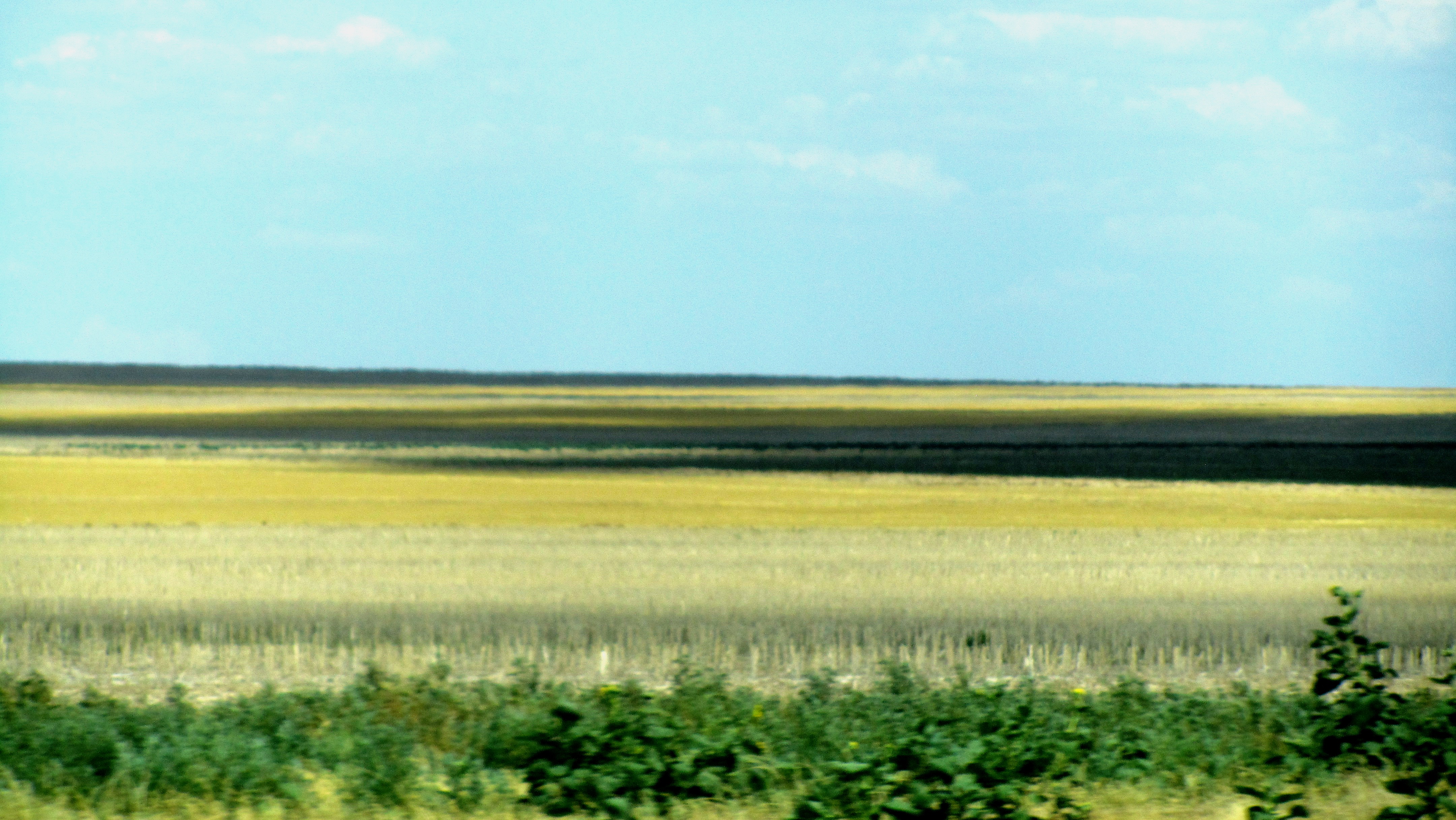
Great Plains horizon
The Great Plains are a large expanse of flatness, this summer roasting with heat and dry to the bedrock. The corn isn’t growing. What sadness to look at fields that should be wavy with tall green – elephant’s eye and all that – and they are instead spotty with stubble and brown.

Just another drought or portent of things to come
How drivable this country is though. There is rarely a sight that is grand or unusual in any way but the roads are good and straight with no traffic or signs or cops or stray animals. The freeway is unnecessary. On these roads cutting up and down and kitty corner across Kansas and Nebraska you can drive as fast as you want, pull over on a dime for a photo op and find gas and coffee as often as you need. What is lacking in scenic views is more than made up for in a delicious sense of freedom.

Where there’s Mexican food there’s hope
I am at a motel called the Sleep Inn. Indulging my obsession about keeping a window open extracts a price here in Oakley, Kansas. There’s a feed lot just south of us and every other breeze blows in the delightful scent of cow manure. Actually it is preferable to the perfumed spray that usually saturates roadside motels. Didn’t motels in Kansas cost $35 a night in some not-too-distant past…now it’s $100.
It was 119° at one stop today. 113° when I checked into my room.

Well not much hope
The goal is to read much of Ian Frazier’s Great Plains tonight so I have things to write about tomorrow night! (He is my source of just exactly what territory comprises the Great Plains.)

Road Trips…still the best travel of all!
Chapter ONE: Lists
I love lists. And I love to travel. On road trips these two loves intermingle freely. Especially as I prepare.
Be aware. You may find evidence of a (relatively harmless?) case of obsessive-compulsive disorder as you read.

Hoping for northern cool…
Tomorrow morning I will leave for:
- Sioux Falls
- Roseau
- Grand Rapids
- Minneapolis
- Reykjavik
- And at least two small towns with characterless motels
I will travel on Highways:
- I-25 to Trinidad CO
- Un-numbered to Highway 96
- 96 to Sheridan Lake
- 385 (I think) to Cheyenne Wells
- 40 to Oakley KS
- 83/383 to Woodruff (still in KS, but barely)
- 183 to Holdridge NE
- 6 to 14
- 14 to Niobrara
- 12 to 81 (crossing into SD)
- 81 into Yankton & on the 42
- 42 to 29 into Sioux Falls.
There will be additional lists necessary to continue beyond Sioux Falls. It is clear my obsessive compulsive impulses extend to Atlases.
Packing. It is sheer luxury not having to subject every single pair of footlets, every scarf, every book, every liquid to lengthy consideration as to weight or threat level. So why not take everything I could possibly want or need over the next three weeks. Oh sure there are shopping opportunities everywhere but why buy toothpaste in Roseau when I can haul it from Albuquerque. So here is what is going into my car:
- Suitcase for Summer pants shirts sweater for up north
- Suitcase for Warm clothes for Iceland
- Overnight bag for change of clothes pajamas books toothbrush for on the road
- Backpack for laptop, portable printer power sources pet mouse
- Backpack for notebooks diaries journals atlases
- Shoes
- Favorite blanket and pillow
- Backpack for trip books
Trip books
- Northern Lights Tim O’Brien
- Americana Hampton Sides
- A Popular History of Minnesota Norman K. Risjord
- Great Plains Ian Frazier
- The Lost Continent Bill Bryson
- From the Hidewood: Memories of a Dakota Neighborhood Robert Amerson
- Norway to America Ingrid Semmingsen
- Koochiching Hiram M. Drache
And
- Bitter Sanctuary Marjorie Neset (the half-written [a third of which is brilliant/a third mediocre/a third really bad) novel which, while at my brother’s in Grand Rapids, I intend to reread and decide whether to toss, fix or ignore for another 10 years.
Of course it would be impossible to read all of this material AND drive AND talk to my relatives AND sleep. But I had to share the fact that I’m not taking my usual detective/murder lit.
Finally. About food.
Usually I buy Fig Newtons and Cheetos for $10 or so at the gas station. Turning over a new leaf this time I shopped at Whole Foods instead for baby carrots grape tomatoes gluten-free brownies green machine stuff for ONLY $35.
But many food pleasures ahead:
- Marshmallow Malts (like drinking sugar)
- Butterscotch Malts
- Pineapple Malts
- Hot beef sandwiches
- Hot pork sandwiches
- Hot chicken sandwiches (I think I made that up)
- Real grilled cheese sandwiches where the Velveeta oozes out between the white bread
- Walleye for dinner, snack before bed, cold with morning coffee
- Hot dishes
- Jell-O salad
Forgive me. This is a very self-indulgent post. But so much fun. Tomorrow will be more profound and literary!

Going through a lot of Red States…making my Blue State (I hope) statement

UCLA 2012 Teresa the Graduate
Familyland is a lot like Disneyland really. The rides (over the desert or through the air), the excess of food (especially dead animals), happy shrieks of children and their easily amused elders (even more so after generous helpings of San Diego brewpub product), maybe just a little underlying tension that accompanies the necessity of having fun (families being families…), and, of course, the big event that brings you all together, warranting all that travel and expense!

It takes a family…
The EVENT: My first granddaughter, Teresa Magalong Klotzback, is graduating with a degree in Civil Engineering from UCLA. We are so proud. First person in my family to take that college leap up from the solid, but not top tier, state colleges we have been attending. This is a BIG DEAL.

Hatch cut-off
The Road I-25 to the Deming cut-off to I-10 through Tucson to eventually pick up the 8 which will cross some tiresomely bleak bush-sprinkled desert, sand dunes, rocky mountains, run into the 15 in San Diego going north to Penasquitos and Scott, Sandra, Teresa and Steven’s house. Once over the mountains the temperature drops and it is California coastal cool. The house on the hill has been updated with new carpets, bathroom tile, etc. in preparation for selling but all the better to celebrate Teresa’s big achievement.

Steven helps Sara with her future college decisions
Steven’s college; Steven’s goals: Steven is 19, just finished two years of community college and entering UC Irvine to immerse himself in developing and perfecting his budding entrepreneurial skills. Focus of studies will be business economics with some sociology on the side.

Seriously Steven…and what are you studying again?
On his way to becoming a corporate leader with a conscience perhaps. Or not. Steven’s friend, Ashley, will be a doctor. Cousin Sara at 13 has already decided she will go to college in California.

Ashley, Sara, Steven
Smart kids all…

Aunt Marsha and Uncle Robert
Graduation Day: We are up early to get to the 9am ceremony on the UCLA campus, must leave an extra hour or so for the San Diego/other freeways getting to the university.

New Mexico is represented
Robert and Marsha are here from Minnesota; Steven, Michele, Patricia, Sara and me are here from New Mexico—Teresa’s dad’s side well-represented, even outnumbering the Filipino side which is usually not easy!

Graduate with Professional Student Grandmother
This ceremony is for the “nerd” side of the campus, i.e. engineers, computer scientists, etc. There is one huge event for all graduates and then the separate colleges/program areas have their own ceremonies.

Teresa and Yusuke
Teresa’s super great boyfriend, Yusuke, whom we all love, is graduating with an art degree in film studies.
Anyway it’s all good and we’re all very proud and each taking credit in our own ways! I think she inherited her potential to be a life-long student from me!

Graduation lunch in Koreatown
Celebrating with Korean Barbecue: Finally…food, family, friends in Korea Town. The graduate chose one of its many barbecue places for the post-graduation family lunch. Which is okay…especially for meat lovers and aficionados of pickled veggies.

Yummy meat and pickled veggies?
Like visiting Luxembourg, Korean Barbecue is an experience to be had…but one you don’t necessarily have to repeat.

As I climb Black Mountain
My Walk on the Wild Side: Climbing Black Mountain in Penasquitos/North San Diego County is my semi-annual check-up to determine whether I am old yet. Phew…made it up one more time. Went by myself and while trudging along deep in thought a sudden movement and telltale rattle made me leap ahead quite a few steps.

A trek through the urban wilds
Had to get a picture though to prove I was almost attacked by a giant rattlesnake! Well it could have happened. A few days later spotted a coyote on my morning walk in the Bosque which made me feel like I was becoming a real wild life explorer. Ready for my own Nature show.
Party Time

All California cuisine is not alike!
Final evening is the big celebration with aunts, uncles, cousins from both sides of the family and friends from little girlhood, grade school, high school and college all dropping by. There was a dead pig, belly dancing, beer drinking, storytelling, laughter and most importantly Marsha and I managed to take over the TV briefly for the final final final episode of The Killing.

Three generations
Don’t mean to be too sentimental about all of this (although I could have been killed by the GIANT rattlesnake and missed the party) but it really was a perfect time and life is too complicated to take such lovely occasions for granted. So here’s to many more visits to FAMILYLAND in the years ahead.

And a good time was had by all…
Around 8am, the third of three ABC buses bound for Lagos, Nigeria with stops in Lome and Cotonou pulls out of the Accra station. I have some deep-seated fear of not making it to wherever I am supposed to be on time so I have been up since 4am, downstairs checking out of the hotel and waiting for the night staff to find a taxi to the bus station…in a part of town with no taxis…which takes a long while.

Accra Bus Station
Down at the station all is apparently chaos but it turns out to be purposeful chaos. There are three buses that leave about half an hour apart and since most people seem to be traveling home to Lagos for vacation or longer there are many many cardboard boxes, once containing product—diapers, soap, soft drinks—now filled with everyday clothes, presents for the babies back home and bedding for the room back home; and the ubiquitous plaid plastic bags—the real suitcases of the 99%; and there are some regular suitcases, not a single one from REI. People are shouting and jostling and negotiating forcefully with the ABC staff…and somehow it all gets loaded and everyone’s on board and the first bus pulls out almost on time.

The bus pulls out
I am the only white person, the only little old lady in jeans and a t-shirt, the only silent one except when I ask ABC staff yet one more time will I know when to board the right bus. What makes me very happy is that I am completely comfortable in crowds of people not like me in one way or the other. In Taiwan, I seemed to be the only non-Asian in my neighborhood or my hotel. In Romania the people were white and there were a lot of older people on the buses and train but no one who spoke English, no one of my age in jeans and a t-shirt, always reading, always taking pictures. In West Africa, the people are all another color and more boisterous than me. But I am a natural observer, not a particularly clever or thoughtful observer, but always content to watch people. And they watch me only a little. Probably the thing that is the most different about me is that oldish women in the rest of the world do not often wear blue jeans! Sometimes I AM proud to be an American (we invented blue jeans!—I think).

The ABC Bus.
Buses are the best means of travel. You get to be with the regular people of the world; working class people like me drive cars in some places but in much of the world they’re riding on buses and trains. For a long trip you ride a “luxury” bus otherwise the local van/buses that move on as they fill up are the way to travel. I went on one of these market buses from Maputo to Swaziland and it gave my travels some sort of authenticity (to me!) that I hadn’t claimed before.

Out the bus window
As the bus pulls slowly out of the station the Sunday morning sermon begins. Twenty minutes of “Praise Jesus” and “Lord Be Merciful” later we are safe to journey on. The sermon would not have been out of place in any Baptist church in the American south. Africans on the whole are quite religious. Christian generally, those missionaries really got around, but of course as you go further north, more Muslim. And the indigenous religions are strong in this area.

The kid on the bus
ABC buses are comfortable and well-maintained as advertised. While not quite “luxurious” there is a toilet and meals for each leg of the journey. The meals, rice and chicken, looked tasty but since I try very hard to avoid public toilets, whether on African buses, Romanian trains, United, Delta or American airlines or gas stations in Phoenix. I did not eat or drink for those hours which, fortunately, does not bother me …being apparently part camel.

The salon
The West African countryside rolls by as the bus speeds along the 118 miles to Lome.

And just over there is the ocean
The view isn’t grand especially since I’m in an aisle seat and the window is smudged. But I snap away. I am not comfortable taking pictures of people and homes up close and personal so most of my photos are taken from bus and taxi windows…hence the sometimes questionable quality.

On the road
Takes half hour or more to get through customs. But walking through the checkpoints—get stamp out of Ghana, walk into Togo for the next one makes it all real. I have my colorful visas for all of these countries so it’s very hassle-free.

The Dead
To TOGO. But first an explanation/confession. I usually read anywhere from a little something to quite a lot about countries before I go there. I admit to not doing that with Togo or Benin, neglecting to get any “neighborhood” background before my two-day drive through. My excuse is this: I travel alone and either do not or cannot pin down precise information about many places I visit…so as I have whiningly stated in other blogs, much of my time is taken with simply finding out how get to the next country or city; ditto the next hotel; where to eat; in French-influenced countries getting Africans who speak one brand of French to understand the abysmal pronunciation of my 20 French words and phrases; getting new money ( I will go from Ghanaian cedi to Togo and Benin’s CFA’s to Nigerian naira) and trying not to get too much because the next country won’t take it…and I am hoarding my dollars for when I cannot change money or use a credit card. Everyone still takes dollars and Euros but keeping track of how many of any given currency equals X number of dollars is no small trick by the third country.

Everyday things
So all of that is my explanation for why I did not explore the cities of Lome or Cotonou but instead spent my few hours observing!, napping, reading “Let the Great World Spin”—preparing for my return to Albuquerque and my book club! But that all counts as exploring the neighborhood even though I was NOT seeing monuments or eating at one of the many fried chicken spots.
About TOGO:

Togo’s flag
Very small, tropical sub-Saharan; official language French; while parts of this region of West Africa were called the Gold Coast, maybe its more apt moniker was the “Slave Coast” since West Africa is where much of the transAtlantic slave trade was based. There was one president, Gnassingbe Eyadema, from a 1967 military coup until his death in 2005; his son, Faure, is the current president. It’s colonial history goes something like this: Originally colonized by the Germans, Togoland was invaded by British troops from one side and French troops from the other during WW I, afterward separated into League of Nations mandates, then UN Trust Territories. The residents of British Togoland voted to become part of Ghana while French Togoland because an autonomous republic of France. A fine example of the craziness of colonial mentality.

The Bight of Benin–the sea along the West African coast
There are 40 ethnic groups in Togo, the largest being the Ewe. 51% of the population maintains indigenous religious beliefs, 29% are Christian and 20% Muslim. Come to think of it the “Jesus Saves” bumper stickers were scarce. This is a place where if I had been traveling with someone who said “let’s at least go to the museum” I would have seen some of the local sculptures which are influenced by the native animistic practices. Alas I didn’t.
I have a few shelves of books about all things African. But I’m lazy so my bits of basic info about Togo and Benin come from Wikipedia.

The coast along Togo, Benin
Here’s what I did do. Found my way by taxi to Napoleon Lagune. I am including most of my Trip Advisor review here for your general amusement!

Togo cat
I just checked the web site again to see if memory (from April of this year) is serving me well. And yes, it does look quite charming upon arrival. The outdoor restaurant so pleasant, the hotel cats so cute, the lagoon right in front of the hotel with the picturesque fisherman drifting along!

Reading “Let The Great World Spin.”
Even the room was okay in spite of the lamp with the red velvet shade that I had to place on its side to have enough light to read. It was bare bones but everything worked and it was quite cheap. The desk staff was okay if nothing special.

The man on the Lagoon
The RESTAURANT was the PROBLEM. Since the hotel appears to be French owned, certainly French operated, I expected okay food…at least okay onion soup and baguette! WRONG. I have never seen onion soup as clear as water with a few slices of onion floating in it and a couple balls of gummy cheese on top. And breakfast the next morning consisted of instant coffee and chunks of bread obviously left over from dinner the night before. And to top off the dining experience, the wait staff was probably the surliest I have experienced–maybe EVER!

That is NOT a baguette
I did have a pizza in the evening just across the driveway, still part of the hotel I think. It was the equivalent of bad stateside pizza, limp and greasy. I asked about a store in the neighborhood and received blank stares and that emphatic French “no!”

Don’t go here
And I had a beer and admired my Togo visa and passport stamp. And was satisfied.

By the sea, by the sea, by the beautiful sea
Back on the on the ABC Lagos bus mid-morning after an argument with a taxi driver about fares. I really don’t believe in bickering over cab fares in poor countries and I leave large tips everywhere…(well, except that hotel restaurant), figuring if I can afford to travel to far places where earnings are so meager and the lives of the workers are so hard then I can afford not to be one of those obnoxious quibblers from the west. But every now and then I snap…it was the onion soup made me so cranky.

Gas station
About BENIN: Generally the same “sandy, coastal plain…marshy…dotted with lakes and lagoons communicating with the ocean” as Ghana and Togo. Interestingly, Benin has quite a different early and post-colonial history than Ghana and Togo. It was ruled by the Kingdom of Dahomey which was known for its military elite including “an elite female soldier corps, called Ahosi or ‘our mothers’…and known by many Europeans as the Dahomean Amazons” War captives of Dahomey were either sold into transatlantic slavery or killed in special ceremony known as Annual Customs. The French took over in 1892 and finally granted Dahomey independence in 1960. One of the several rulers prior to a turn to democracy in 1991 is probably worth mentioning just for his sheer weirdness. In 1972, Lt. Col. Mathieu Kerekou overthrew the ruling triumvirate. He announced the country was officially Marxist and established relations with China, North Korea and Libya; then he converted to Islam and changed his first name to Ahmed; then he became a born-again Christian and changed his name back again. And we think Romney is a flip-flopper.

Floating village
The ABC bus to Cotonou, about 84 miles and another border crossing. We arrive late afternoon on the edge of town and then there’s the hassle of finding transportation to the hotel. All the motorbike riders want me to go with them…saying “safe, safe.” I almost acquiesce but there are no helmets and the driver will carry my suitcase (small but not that small!) in front of him on the bike and traffic is intense and I remember my broken elbow last summer and finally say NO. A real taxi finally arrives and we go the distance to the Hotel du Port. Here’s my Trip Advisor review:

I could be a spy…I know I could
The Hotel du Port is an attractive pleasant hotel. Maybe a little above average. Very nice pool and dining area, food was good, decent Pasta Alfredo, cold beer, lovely patio area. Room was also very nice looking although a little hard to operate. I finally used a Gideon bible to prop the headboard away from the wall which otherwise shut off the lights over the bed. Phone didn’t work unless you played with the cord so I was up and down the stairs a few times to get things like towels and water for the room. Still and all, average +

If you go here, remember to prop the bible behind the headboard
The restaurant staff was welcoming, the hotel staff not so much so although certainly not rude. Partly of course it is my lack of language skills in countries where only French and the local languages are spoken. Does try their patience I know.

Church where the Cuban spies exchange plain brown envelopes and secrets
The spy reference comes from the fact that my room looked down over the Cuban Embassy and I am a spy/detective novel aficionado extraordinaire. So I pretended I either worked for the CIA or was John LeCarre starting my next novel about a Cuban spy in Benin waiting for hapless Americans to appear!

Getting to work
I decided to ditch my ABC bus and hire a driver to Lagos so I actually could see the countryside. Fortunately I had saved dollars for this very purpose so it was time to use them.

Every now and then…A Pretty Picture.
Left in the morning about 10am for my really short but splendid Nigerian adventure. See Chapter IV next week.

The end
CHAPTER IV HAS DISAPPEARED. NIGERIA WILL BE REVISITED AT THE END OF THE BLOGGING BOOKS! If I find it.

Flag of Ghana
It is not all golden on the Gold Coast, as colonial Ghana was known, but it’s not bad either.
Felix Ofosu Dompreh and Naa Ayeley Okine, my two dancer friends, are proud of the peace and stability of their country and they talk about it in a way that doesn’t occur to us—as a special circumstance to be treasured, not a state of affairs to be taken for granted. It was nice to hear.
Ghanaians are proud of their peaceful land. Proud of their friendship with the U.S.; proud of their education system, quite likely the best in the region; proud of President Obama’s choice of Ghana for his first trip to sub-Saharan Africa as president.
A few lines from the President’s speech: “And I have come here, to Ghana, for a simple reason: the 21st century will be shaped by what happens not just in Rome or Moscow or Washington, but by what happens in Accra as well….
Time and again, Ghanaians have chosen Constitutional rule over autocracy, and shown a democratic spirit that allows the energy of your people to break through. We see that in leaders who accept defeat graciously, and victors who resist calls to wield power against the opposition….
Fifty-two years ago, the eyes of the world were on Ghana. And a young preacher named Martin Luther King traveled here, to Accra, to watch the Union Jack come down and the Ghanaian flag go up. This was before the march on Washington or the success of the civil rights movement in my country.” (I’ve excerpted some other phrases and paragraphs from that speech at the end of this blog.)

Noyam Dance Company
My time in Ghana was very short, intended to make acquaintance with the local contemporary dance world AND to get yet one more passport stamp. Felix, Naa and their friends made the time informative and most enjoyable from a dance and a social perspective.

Out the taxi window
We had agreed to meet on my first evening in Accra at the Alliance Française for a concert. It was most agreeable as events at French cultural centers across Africa usually are. A mix of ex-pats—mostly French, middle-class Africans, and artists of all shades; friends greeting one another in the velvet humidity of a typical tropical evening; a lively beer terrace—exclamations and embraces all in French.

And the music—the very intriguing, very African sound launching Togbui Ehadzila Dela Botri’s new album, Naa Ayele, described in the promo as ‘a dramatic fusion of contemporary highlife/kpanlogo, zouk and salsa rhythms harmonized to create a new sound and promoting Ghanaian rhythms.’

The music of an African evening
After the concert Felix and friends drove me by the monument-filled heart of the city while searching for my hotel which, in spite of what the on-line promo claimed, was actually in a rather obscure corner of the city. Nothing about travel is quite as pleasurable as driving or walking about a new city with newly-made friends just sharing stories and laughter.

At the rehearsal, Noyam Dance Company
I took a cab the next morning out to the University of Ghana for a Noyam Dance Company rehearsal and to see one of their smaller pieces performed. The dancers are quite excellent, the new work in rehearsal looks like it will develop into something interesting and piece they performed for me was engagingly choreographed and danced with grace and energy. The work does have an American look to it, based perhaps on Ailey although I am not familiar enough with his work to say that with confidence.

Naa and Felix
We all talked for awhile in the studio and the issues would sound familiar in any American dance studio—shortages of space to create and rehearse, money, places to show the work… These dancers have traveled a fair amount individually, whether to the States, Europe or in some cases to lengthy residencies in Japan and the company has performed at least once in the States. While there isn’t a lot of financial support available Noyam is under the umbrella of the University which provides space and at least some opportunities as long as you are a student.

Drive-in restaurants, African-style
In the afternoon four of us headed for the beach. A perfect time it was. The talk was good: politics (one friend had volunteered on Barack Obama’s campaign while studying/visiting in the States), their ethnic/cultural backgrounds, food, dance, life.

Reaching the beach
The food was beautiful.

Yes, it is fish
The beach was the perfect place to while away a lazy afternoon happily chatting over new tastes and good beer.

ME. GHANA.
These lovely Ghanaian beaches were also the last familiar glimpse of their homeland to the victims of the trans-Atlantic slave trade.

A sad scene for many
The company was fascinating.

Friends
My desire to feel at home in the WORLD is slowly being achieved, country by country, meal by meal, bus ride by bus ride, friend by friend.

At home in Ghana
Tidbits of information, mostly culled from Wikipedia, follow along with photos. They are in no particular order and have no particular relationship to each other.

Before and after dinner
Fact: The Gold Coast, as colonial era Ghana was known, became the first sub-Saharan African nation to achieve independence from the UK. On March 6 1957 at 12am, Kwame Nkrumah declared Ghana “free forever”.

Important public building, monument?
Fact: Ghana is one of the world’s largest gold and cocoa producers.

Good building
Fact: Ghana was part of the Ashanti Empire, one of the most powerful pre-colonial states in Africa.

Says it all…
Fact: John Atta Mills is the current president.

Fact: Ghana is ranked as a Lower-Middle Income Economy by the World Bank.
Fact: Ghana lies just north of the equator.

Carside service
The main ethnic group is Akan; 69% of the people are classified as Christian; English is the official language.
Ghana made it into the quarter final stage in the 2010 FIFA World Cup. Yay, Ghana.

Really?
Ghana enjoys a mostly free press.

University of Ghana near dance studios
Ghana had a 71.7% literacy rate in 2007 for males and 58.3% for females.

Evening’s over
According to my friends, Ghana has the best education system in the region and many students come from elsewhere, especially Nigeria, to study here.

U.S.-Ghana-Friends
Things I especially like from the President’s speech: Now let me be clear: Africa is not the crude caricature of a continent at war. But for far too many Africans, conflict is a part of life, as constant as the sun. There are wars over land and wars over resources. And it is still far too easy for those without conscience to manipulate whole communities into fighting among faiths and tribes.
These conflicts are a millstone around Africa’s neck. We all have many identities – of tribe and ethnicity; of religion and nationality. But defining oneself in opposition to someone who belongs to a different tribe, or who worships a different prophet, has no place in the 21st century. Africa’s diversity should be a source of strength, not a cause for division.
That is why we must stand up to inhumanity in our midst. It is never justifiable to target innocents in the name of ideology. It is the death sentence of a society to force children to kill in wars. It is the ultimate mark of criminality and cowardice to condemn women to relentless and systematic rape. We must bear witness to the value of every child in Darfur and the dignity of every woman in Congo. No faith or culture should condone the outrages against them.
As I said earlier, Africa’s future is up to Africans.
The people of Africa are ready to claim that future. In my country, African-Americans – including so many recent immigrants – have thrived in every sector of society. We have done so despite a difficult past, and we have drawn strength from our African heritage. With strong institutions and a strong will, I know that Africans can live their dreams in Nairobi and Lagos; in Kigali and Kinshasa; in Harare and right here in Accra….
Freedom is your inheritance. Now, it is your responsibility to build upon freedom’s foundation. And if you do, we will look back years from now to places like Accra and say that this was the time when the promise was realized – this was the moment when prosperity was forged; pain was overcome; and a new era of progress began. This can be the time when we witness the triumph of justice once more. Thank you.”
SMELL HEAR SEE TOUCH TASTE

African night–tail lights and noise
All at once, pleasant and repulsive, appealing and annoying. Too much. Want more. Probably everyone who has written about Africa has included descriptions of the sensory assault that takes place from smoky gray dawn through the thick black night. Especially in the crazy busy cities of West Africa.

Daytime traffic and fast food
Smells of dust, exhaust, sweat, roasting meat, impromptu toilet, baking bread, clothes dried too slowly, overripe mangoes ease and ooze around a hullabaloo of horns, clamor of vendors, never-ceasing roar of generators, quarreling shouting blessing greeting protesting humanity.

Music and Africa cannot be separated.
In and out, over and under, a musical phrase of Afro-pop, a drum beat of Afro-traditional, will sweeten the moment and always lure you back.

Spoon/fork
You touch each other in tightly packed vehicles; you touch the sticky white pounded yam ball, the spoon/fork of everyday eating, as you pull it apart to scoop up hot meaty stew. You feel the sweat that is always running tickling salting your skin.

Handsome dancers
Seeing the turmoil that is Accra, Lomé, Cotonou, Lagos without the aid of the other senses would be a disappointing experience since the cities’ beauties are not easily beheld—not with expectations of grand buildings and lush green spaces. For beauty, you must see the people, and Africans in general are strikingly handsome. Spending time in Africa confirms the suspicion that white people are the least impressive in appearance of all of the races and groupings and categories of humanity. The truth is Africans and Asians make the rest of us ‘pale’ in comparison.

Shopping
Markets are where it all happens and they occupy every side street, roadway, public space. They are African eye candy. Of course every city has at least one giant mall and luxury shops exist in rich Euro/African neighborhoods but nothing of interest happens there as they are identical in every city in the world. Just extra large/extra pricey duty free shops that have escaped their airport confines.

And lunch
The markets on the other hand are same different odd ordinary enticing exhausting across Africa (and Asia too). Never never never dull. There is always warm meat hanging somewhere and stacks of tires dominating whole streets. But the cloth of many colors and circles squares dots flowers gilt embroidery that most women and men still wear sell sew is the background scenery of all activity.

Mangoes–the best
And then there are the cleverly arranged stacks of mangos and tomatoes and gum and shampoo and shoes in Technicolor bits and pieces occupying every nook and cranny, the very opposite of ‘big box’ stores so beloved of Americans.

Bread store
About taste. The favorite sense of most travelers. I am a foodie failure…mostly subsisting on bread. I can vouch for the soft yeasty sweetish bread of Nigeria and the Philippines and the good solid bread of central Europe and, best of all, the baguettes of France but beyond that I cannot comment. Four of the senses must suffice.

Nice picture inside art center

ACCRA to LAGOS by BUS
Sunday morning, 4:30am a short intense working trip begins. Reviewing grant applications in Durham, North Carolina; meeting some dancers and arts administrators in Accra, Ghana; buses to Lomé, Togo and Cotonou, Benin. Time with a most intriguing dance artist in Lagos, Nigeria.
Keeping a smallish combo backpack/suitcase lightly packed no matter the demands of that extra pair of jeans to go along. But I am leaving my Kindle at home. I do not like it. There must be room for books even if more clothes are jettisoned. A new Icelandic murder mystery—or two. A biography of Alexander Hamilton or my book club novel. The mix should keep me amused on sleepless nights.
Biggest decision. No computer. Just me and my Droid. Who have never really bonded. So back to the days when I spent much of my time on the road in coffee shops writing…by hand…with a notebook…and a pen. Remember that? It was most pleasurable, especially at sidewalk cafes, especially with café au laits, especially with cigarettes…especially in Paris? Never mind. That was then, this is now. No cigarettes, no Paris. Will Accra have a Starbucks?
It is my birthday today. I am celebrating with a new bed. Where I will spend a third of the rest of my life I suppose.

Where dreams of travel begin
I had a perfectly reasonable double bed with a double-bed mattress and double-bed springs. It even had history. The bed once belonged to my friend Gordon. It was, in fact, his childhood bedroom set with covered wagon carvings and a wagon wheel headboard. I painted it black to draw attention away from those childish decorations but now that I think of it, the wagon wheel probably lent itself to the dreams of the precocious little boy who once inhabited the bed—and much later to the aging wanderer that is me.
I have been feeling like a good friend just departed. Eleven years I spent in that bed. Sleeping well. Not well. Middle of the night detective novels. Restless leg syndrome. Burrowing in on cold mornings. Not so many places, people or things more intimate than a bed.
However…today I move on. A new bed. A birthday gift from my brother and two sons. We started out a few days ago with a foam bed…a less expensive version of Tempur-pedic. Hated that. Like sleeping on a futon or a softish board that retained heat. Felt dead, inanimate, impassive. It is back at the store.
NOW, I have a brand new normal king-size bed. All clean and shiny and springy—no dust mites—those little hairless tarantula-like creatures that supposedly inhabit all of our beds, couches, chairs, pillows……………eeeeek!
This transition reminds me of other beds of which I have been fond. My first bed for example. Minnesota cabin. And a mom who firmly believed that all little girls need their own room, bed and privacy, and bought a new bed for me when money was ever so scarce. Thin mattress, stiff springs, and a brown faux-oak headboard so tinny that it clanged if you barely touched it. My tiny room with the squeaky bed was my refuge in a small crowded house with four people, two or three dogs and various lambs or birds or ducks depending on who needed shelter at what time of year. I loved that room and that bed. Where I dreamed of books and cities.
Then there was the marriage bed. It was okay.
And all of the beds in all of the apartments and hotels all over my world. Boards covered by thin mats in Egypt and the Philippines. Big king feather bed with many-thread-count sheets watching a Queer Eye for the Straight Guy marathon because the conference I was attending in Chicago was so unutterably boring. Beds with blankets reeking of cigarette smoke in 1-star Paris hotels. Beds in my friends’ Manhattan apartments where the dogs curled up near my head all night. Mattress on the floor in Ouagadougou observed in the night by a big fat spider. Mattress that smelled ever so faintly of pee in a cute attic room in Suceava.
And I suppose eventually the death bed.

Spices from Tunis

March Madness would be Global DanceFest, a California visitor, dust and pollen storms, rearranging my apartment for a new king-size bed and a better writing space AND changing my blog categories. If all of this goes ahead (or away in the case of the storms) as planned by my April birthday a new writing life will be in place.
How many times have I said that? Okay. Many.

The women in black at GDF
Global DanceFest has been an artistically innovative and personally satisfying 12-year program presenting original artists from around the world in Albuquerque New Mexico. The spring/summer brochure listing many of those artists can be downloaded at vsartsnm.org/pdf/VSA_Season_2012_Program.pdf. Now we move on to Journeys: a Global Celebration of Dance and Discourse in September 2012, a smaller, more focused program.

Radhouane El Meddeb
Meanwhile our last Global DanceFest has brought friends from North Africa dancing to couscous-making and coffee. Radhouane El Meddeb (1st visit) represents a long-term commitment to bring new artists to Albuquerque and Hafiz Dhaou to maintaining long dance relationships (3rd trip).

Hafiz Dhoau and Aicha M’Barek
AND THEIR BABIES.


AXIS from Oakland returns next week restating North Fourth Art Center’s mission of showcasing the creative excellence of artists of all abilities. And finally in April, Wally Cardona will present the grand finale performance, Tool is Loot, which will surely prove to be an original, unusual and brilliant work by this NYC artist with NEW MEXICO roots. GDF has been an adventure…a good one…time to move on.
California son came out for a weekend. Whatever one says about extended families nothing is quite as good for moms and/or dads as time with their very own kids, the original nuclear family!

mom and the boys
While home Scott discovered Marble Brewery where, unlike in San Diego, you can bring your own food and guzzle their beer. And I made blue-gray lumpy (blueberries and sour cream) pancakes that were, nonetheless, delicious.

Scott and Sara (the ‘baby’ of the family)
Dust and pollen–spring in New Mexico. Weather here appeals to many because of the endless sun. I prefer clouds and rain—Hilo, Hawaii being my idea of the perfect climate—but here I am. And there are those magic moments such as when you go to bed one night and the trees are stark dark branches and you awake to spring green coloring over the gray.

See some new green back there
The pollen is to be expected of course but the dust storms are an evil of this dry land. The wind blew so hard yesterday that there are small dunes across the porch.
AND THE BLOG. Why is it so hard to do what I want with this blog. It is surely the epitome of a love-hate relationship. How liberating to have a place of my very own to write whatever I want and have it be instantly published if I so choose. How terrifying to want it to be well-written and interesting and never find the time to make it so.


Cathy
Cathy Zimmerman, Ken Foster, Laura Faure, Joan Frosch, Philip Bither, Vivian Phillips, Shay Wafer and Marjorie Neset—The Africa Contemporary Dance Consortium (TACAC) U.S. representatives—all arts professionals in some fashion: administrators of centers and festivals—big and small, urban and almost rural; writers; curators; scholars.

Gregory and Phillip
The link that brings us all to a meeting in Johannesburg, Gauteng Province, South Africa is our common desire to understand, in deep and personal ways, what it is to make art in a place far from our familiar U.S. territory. And, as importantly, to develop authentic friendships with artists from this continent, that weave through our personal and professional lives in profound and joyful threads.

Shay
Three of TACAC’s African affiliates join us for this meeting: Boyzie Cekwana, Gregory Maqoma and Nelisiwe Xaba, all South African artists of intelligence, originality and talent. Affiliates from Congo/DRC, Mozambique and Kenya were absent in person but offered thoughtful input via Cathy Zimmerman.

Laura
It is a long way here—14 to 30+ hours depending on your starting point. We arrive jet-lagged, immediately leaping into the striking and stimulating new work we have come far to see. Which activates sufficient adrenaline to get us through those first hours and days!
-

- Neli
-

- Boyzie
In our informal but intense meetings we address issues both resolvable and not! It is truthful to say that our motives for being here are pure.

Joan
In other words it really is about friendship and deepening our understanding of each others’ cultures and work—no rewards of prestige or money accompany these relationships.

Vivian
Of course we hope that our coming together will result in increased exchanges of art and ideas between African artists and our U.S. communities and, ultimately, between artists from both continents traveling, making and sharing work and becoming friends and ambassadors in a rapidly expanding global community.
-

- Cathy
-

- Marj

Ken, just arrived.

A little later.
But there is something more we talk about at our meetings and over subsequent coffees and lunches—what is it about these particular friendships that make them so important?
Definitely a deeply-held, but frequently unacknowledged, desire to cross cultural lines, proving to ourselves and others that we really do share a common humanity.
Certainly a level of admiration for African friends’ determination to make work that is artistically powerful and original—and that also addresses issues of personal, community and global concern.
Certainly a level of admiration for African friends’ determination to make work that is artistically powerful and original—and that also addresses issues of personal, community and global concern.
-

- Ken and Cathy…dance, it’s serious.
-

- Cathy and Laura…but not all of the time.
Always pursuing our curiosity about how environment manifests itself in artistic creation?

We all share fun and laughter, wine and food—and our friendships deepen—and we all renew our commitment to dance and global citizenship.

Once in awhile we sleep.
